Category: Insights

  • Future of Search Engine Optimisation

    Future of Search Engine Optimisation

    Search Engine Optimisation (SEO) has never been a static discipline. From keyword-focused content and backlinks to mobile optimisation, voice search and artificial intelligence, the way people discover information online has changed significantly over the years.

    Today, SEO is entering another major transformation. The growth of generative AI, AI-powered search experiences, changing user behaviour and increasingly sophisticated search algorithms are changing what it means to optimise a website for search.

    The future of SEO will not simply be about ranking a webpage on Google. It will be about making content discoverable, understandable, trustworthy and useful across an increasingly diverse search ecosystem.

    From Keywords to Search Intent

    Traditional SEO often focused heavily on identifying keywords and incorporating them into web pages. While keywords remain useful, search engines have become much better at understanding the meaning behind a query.

    Users are also becoming more conversational in the way they search. Instead of searching for a few keywords such as “best digital marketing courses UK”, a user might ask:

    “Which digital marketing course in the UK would be suitable for someone with a technology background who wants to move into marketing?”

    This means businesses will need to focus more on search intent rather than simply targeting individual keywords.

    Future SEO strategies will need to answer the questions users actually have, anticipate follow-up questions and provide useful information throughout the customer’s decision-making journey.

    The Rise of AI-Powered Search Engine Optimisation

    Artificial intelligence is arguably the biggest force shaping the future of search.

    Search engines and other digital platforms are increasingly using AI to understand queries, summarise information and provide direct answers. Users may therefore have less need to visit multiple websites to find basic information.

    This creates a new challenge for marketers:

    How can a brand remain visible when users receive answers directly within the search experience?

    The answer is likely to involve creating content that is valuable enough to be referenced, cited or incorporated into AI-generated answers.

    SEO may therefore expand from Search Engine Optimisation towards a broader approach to search visibility across traditional search engines, AI-powered search tools, social platforms and other discovery environments.

    Content Quality Will Matter More Than Content Volume

    For many years, publishing large amounts of content was a common SEO strategy. However, producing more content does not necessarily mean producing more value.

    As AI makes content generation faster and cheaper, the internet is becoming increasingly saturated with generic and repetitive material. This makes original, useful and credible content more valuable.

    Future-focused SEO will place greater emphasis on:

    • First-hand experience
    • Original research and data
    • Expert knowledge
    • Clear explanations
    • Accurate and up-to-date information
    • Unique perspectives
    • Strong evidence and trustworthy sources

    AI can help marketers research, analyse and produce content more efficiently, but simply generating large volumes of AI-written articles is unlikely to create a sustainable competitive advantage.

    The brands that stand out will be those that combine technology with human expertise, experience and originality.

    E-E-A-T and Trust Will Become Increasingly Important

    When users search for information, they need to know whether they can trust what they find.

    This is particularly important for topics where inaccurate information can have significant consequences. Search engines therefore have strong incentives to identify content that demonstrates experience, expertise, authority and trustworthiness.

    For businesses, this means SEO cannot be separated from reputation.

    A strong future SEO strategy may involve demonstrating:

    • Who created the content
    • Why the author is qualified to discuss the subject
    • Whether the information is supported by credible evidence
    • Whether the organisation has genuine expertise
    • Whether the website provides a safe and transparent user experience

    In other words, building a trustworthy brand may become just as important as building backlinks.

    Search Will Become More Multimodal

    Search is no longer limited to typing words into a search box.

    Users can already search using images, voice, videos and combinations of different formats. Visual search and conversational interfaces are also becoming increasingly sophisticated.

    Imagine a user taking a picture of a pair of shoes and asking an AI assistant:

    “Find similar shoes that are available in my size and under £100.”

    This is very different from traditional keyword search.

    Businesses will therefore need to optimise not only written content but also images, videos, product information, structured data and other digital assets.

    The future of SEO will increasingly involve making every relevant piece of digital content understandable to both users and machines.

    Technical Search Engine Optimisation Will Remain Important

    While the future of SEO may sound dominated by AI and content, technical foundations will remain essential.

    Search engines still need to discover, crawl, interpret and index websites. Websites that are slow, difficult to navigate or poorly structured can create problems for both users and search engines.

    Important technical considerations will continue to include:

    • Website performance
    • Mobile usability
    • Crawlability and indexability
    • Internal linking
    • Structured data
    • Website architecture
    • Accessibility
    • Security
    • Core Web Vitals and user experience

    The difference is that technical SEO will increasingly work alongside content strategy, analytics, UX and product development rather than operating as an isolated marketing activity.

    SEO and User Experience Will Become More Connected

    A website can rank well and still fail to achieve its business objectives.

    If visitors cannot find what they need, understand the information or complete an action easily, traffic alone has limited value.

    Future SEO strategies will therefore focus more strongly on the complete user journey.

    A successful page should not only attract a visitor from search. It should also provide a smooth experience that helps the visitor accomplish their goal.

    This creates a closer relationship between SEO, UX, conversion optimisation, content marketing and digital analytics.

    Data and Analytics Will Drive Better Decisions

    The future of SEO will also become increasingly data-driven.

    SEO professionals will need to look beyond rankings and organic traffic. Metrics such as engagement, conversions, customer journeys and business outcomes will become increasingly important.

    Artificial intelligence can help marketers identify patterns in large datasets, discover content opportunities, understand audience behaviour and automate repetitive analysis.

    However, data alone does not create a strategy.

    The real competitive advantage will come from combining data with human judgement.

    The Future SEO Professional

    As SEO evolves, the role of an SEO professional is likely to change.

    Instead of focusing primarily on keywords, rankings and backlinks, future SEO specialists may need knowledge across several areas, including:

    • AI and generative search
    • Content strategy
    • Consumer behaviour
    • Data analytics
    • Technical SEO
    • User experience
    • Digital PR and brand building
    • Structured data
    • Marketing technology

    This means SEO is becoming less of a narrow technical discipline and more of an integrated part of digital marketing.

    What Businesses Should Do Today

    Businesses do not need to abandon traditional SEO. Instead, they should build on its fundamentals while preparing for new search behaviours.

    A future-ready SEO strategy should focus on five principles:

    1. Understand the audience.
      Know what your customers are searching for, why they are searching and what problems they are trying to solve.
    2. Create genuinely useful content.
      Focus on answering real questions rather than producing content simply to target keywords.
    3. Build authority and trust.
      Demonstrate expertise through original insights, credible information and real-world experience.
    4. Optimise for multiple discovery channels.
      Think beyond traditional search engines and consider AI search, social media, video, visual search and other emerging platforms.
    5. Measure business impact.
      Connect SEO performance with meaningful outcomes such as leads, sales, engagement and customer retention.

    Conclusion

    The future of Search Engine Optimisation is not the disappearance of SEO. It is the evolution of SEO.

    Search engines will continue to become more intelligent, users will continue to change how they discover information, and artificial intelligence will increasingly influence the search journey.

    The fundamentals, however, will remain surprisingly familiar: understand the audience, provide useful information, build trust and create a great digital experience.

    The biggest change is that SEO will no longer be limited to getting a webpage to rank for a keyword. It will be about ensuring that a brand, its expertise and its content can be discovered and understood wherever people search for information.

    For marketers, the future presents both a challenge and an opportunity. Those who treat SEO as a constantly evolving part of the wider digital marketing ecosystem will be better positioned to adapt as search continues to change.

  • Updates from the Server Room (v1.2)

    Updates from the Server Room (v1.2)

    “Meet customers where they are.” — learning to inspire this week’s updates from the server room.

    Adding the newsletter feature to the Home page was great (read the full story), but we quickly realized how we are missing a really big opportunity that can help many more users sign up for the newsletter. And that is right after they finish reading a blog post.

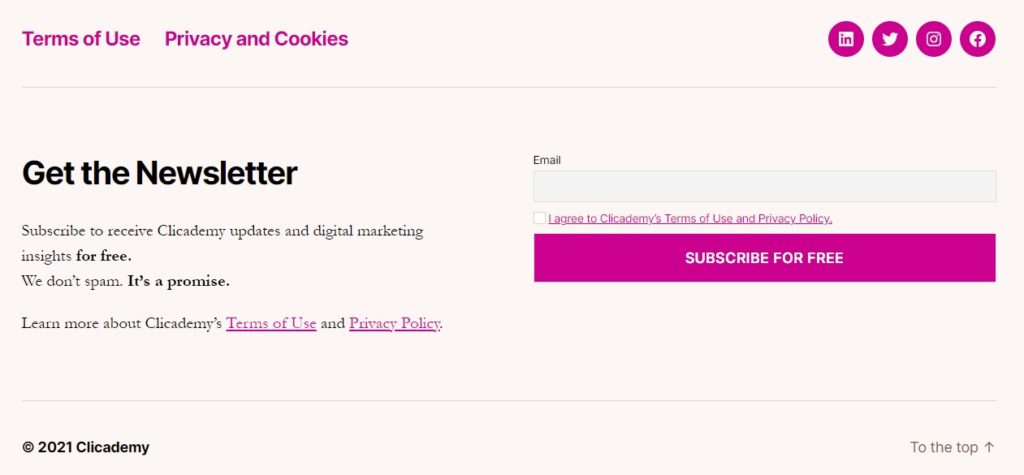
    In the spirit of “meetings your customers where they are“, we decide to add a newsletter sign-up form at the bottom of every blog post. For people who enjoyed reading our articles and would want to sign up for additional content, this would be the exact place where a newsletter sign-up form can help them achieve their goal.

    As a caveat, the WordPress theme we are using requires the newsletter widget to be displayed at the very bottom of the page. Ideally, the newsletter form should be displayed above the footer that has the “Terms of Use” and “Privacy and Cookies” links as well as the social media buttons, and even more effectively, it should be displayed above the “Comments” section of a blog post. We’ll observe the performance and see if there is a need to build something custom that can circumvent the limit from the theme.

    Additional tweaks

    • We have renamed “Dashboard” to “Real Data” in the site navigation. The name echoes our tag line “Learn Digital Analytics for Marketing with Real Data“.
    • We have moved the “Site search” widget from the footer into the top navigation bar. This allows a clean and focused footer that can help the newsletter form stand out.
    • We have added an “Engineering” category in the “Insights” navigation dropdown menu. It will be home to more posts like the one you are reading right now.

    Enjoy reading engineering stories of this Updates from the Server Room series? Scroll to the bottom 👇 and sign up for our newsletter.

  • Last week in Analytics (v1.1)

    Last week in Analytics (v1.1)

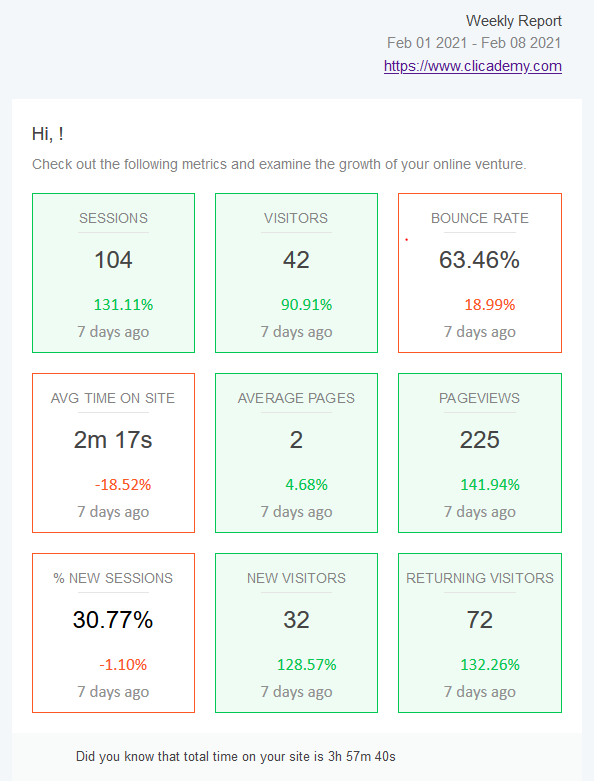
    Clicademy receives every week the website engagement summary from Analytify, which is our analytics aggregator. The summary provides nine metrics to measure our site traffic performance. Visit our real data Dashboard to access much more Analytics data.

    We are still an infant website but had a week of growth from Feb 1 to 8, 2021. Six of the nine metrics went up, compared with only three rising in the previous week. The graph below provides a snapshot.

    What did we do?

    We are still in the stage of building the site. The publicity effort is minimum. Internally we let the site be in the “primitive organic” status. However, a few small things we did seemed to have increased the traffic.

    Firstly we took down the sign-up “paywall” to the Insight blogs, which carries articles in digital marketing analytics and technology. We also gave the site a new home page. The first updates from the server room have the details.

    Secondly, we launched a Clicademy page on LinkedIn to get close to our target audiences who are learning professionals and students in marketing. Some small-scale promotion took place on LinkedIn. The page acquired 7 followers out of 12 unique visitors, registering a 58% conversion rate. LinkedIn and other social media will provide our members with much more analytics data. We are developing technology solutions to automate the reporting of the data. Members, please stay tuned.

    Thirdly we direct-marketed to about 30 digital marketing students in a UK university.

    Worrying Analytics

    Higher bounce rate, shorter average time on site, and fewer new sessions indicate that Clicademy lost some traction with users’ eyeballs. We think the reason was that our data Dashboard because inaccessible for a few days. We corrected the problem by fixing some bugs with our membership plug-in.

    What is more worrying is that we have a very low conversion rate of visitors to registered members. We are yet to find out why. We hope to see better results in next week analytics.

    Help needed

    Clicademy opens up its traffic data and publishes blogs to help students and new practitioners to learn digital analytics for marketing and martech. Please sign up to access the free and real online data. You can also help us by leaving your comments and feedbacks in the comment area.

  • Updates From the Server Room (v1.1)

    Updates From the Server Room (v1.1)

    👋 Bye bye paywall

    With this update, all the posts are now free to read for the general public. You no longer need to sign up for an account in order to read our articles. To achieve this, we have removed access restriction on all Posts/Pages. It was previously restricted with the Ultimate Member plug-in.

    Note that the Dashboard page still requires an account, and it remains free.

    🏠 A new home page

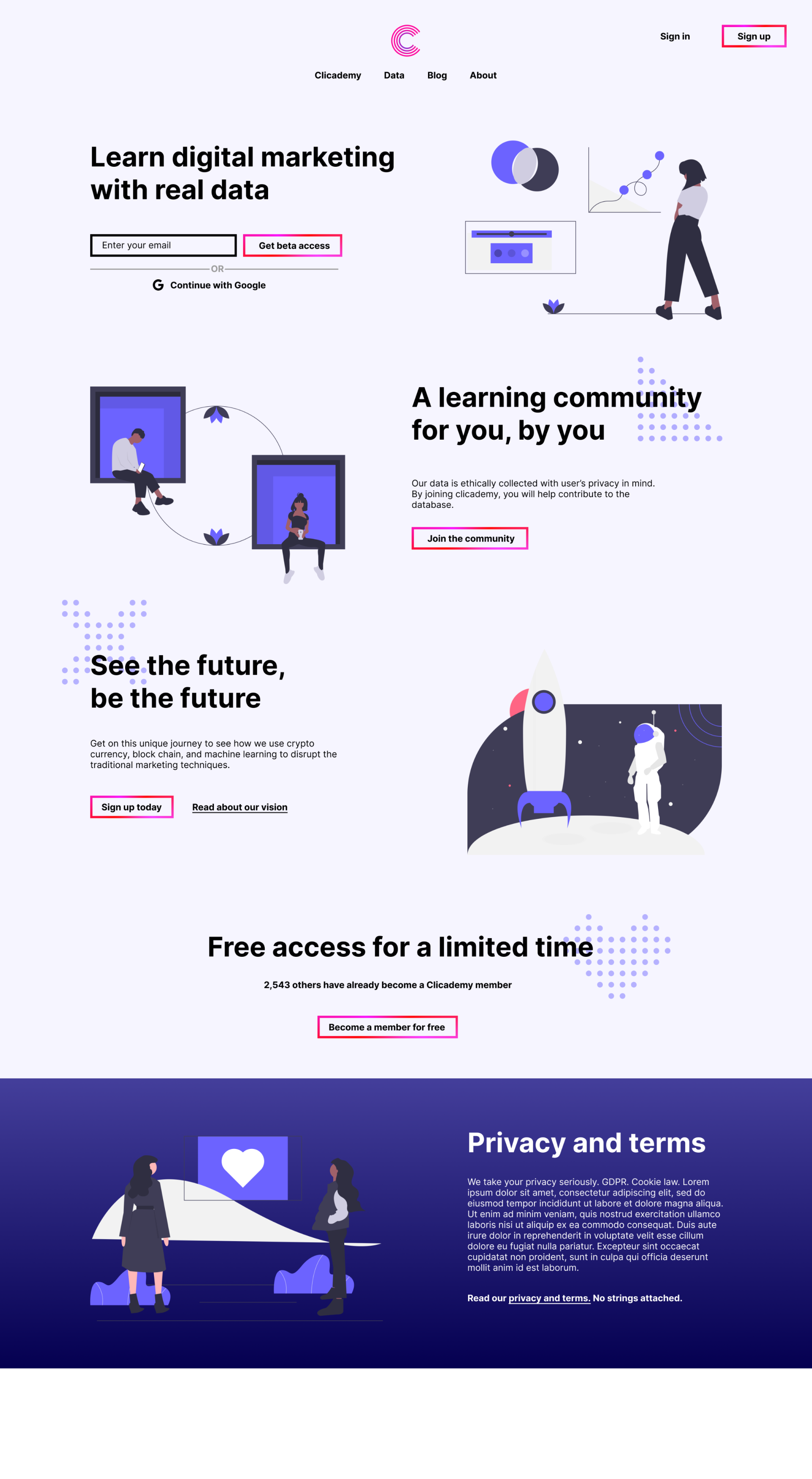
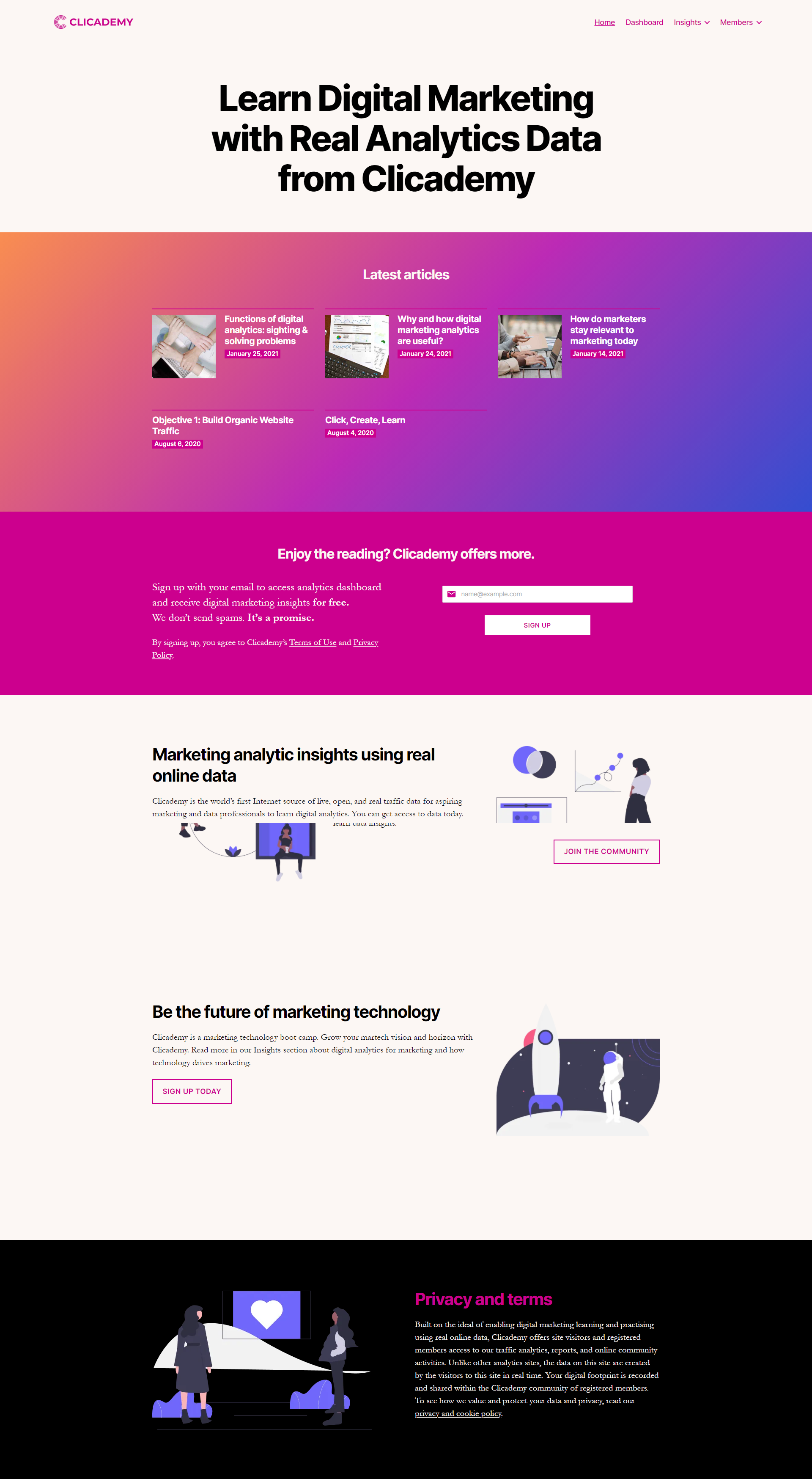
    We constantly tinker our design to explore new possibilities of UI/UX. With this update, we bring in easier access to content and spiced up our visual language with colors, and colors, and more colors!

    Drag the middle to compare: Before and After home page redesign
    • Latest articles are featured above the fold. No sign-in needed to get taste of Clicademy.
    • We are going for the “electric” feel with vibrant gradients.
    • Returning members will get an “Open Dashboard” button frontend and center, allowing quick access to our analytics dashboard.
    • Simplified header
      • We are hiding tag line “Every click counts”. We might use it in other places.
      • We switched from the gradient logo to a singled colored one. It’s Easier to read while conveying a cleaner brand image.
    • New colors: actions, links, and primary buttons now carry a brighter purple/magenta accent to stand out from the default WordPress 2020 accent color, which was darker and more pedestrian looking.

    Lastly, drum roll…

    💌 The newsletter is live !

    • We have integrated with The Newsletter Plugin.
    • Yes, everyone uses MailChimp. We have considered MailChimp. The user experience is great. The integration is simple. There are countless plugins in WordPress marketplace. But it’s just too expensive! TNP has an unlimited free-tier so why not give it a try?
    • User can subscribe/unsubscribe to our newsletter without creating an account. This means if you are currently a member, you won’t be automatically added to the newsletter audience group. If you would like to subscribe, please click the appropriate “Subscribe” button on the Home page.

    <end of transmission>

  • Restricted content

    On 10th of August 2020, Clicademy sets the first marketing objective as to build up organic traffic of the website.

    Sign up a free membership to see how we will attempt the objective and what we will learn.

  • Click, Create, Learn

    Why what you do on Clicademy matters?

    To click, create, and learn summarises the user experience on Clicademy.

    Clicademy is drawn on a blank sheet, starting with zero traffic and zero online visibility. It invites users to experience its beginning and growth to learn the analytics of the site traffics.

    Click start of a journey to learn digital analytics
    Photo by Carmen Ong on Pexels.com

    This experience benefit people interested in digital marketing and its enabling technologies. On the journey with Clicademy, users can do three things: click to use the site, create traffic data, and learn from the analytics.

    Now we are to get more clicks. Clicademy goes live as a minimum viable product (MVP). Clicademists, who are a group of enthusiastic marketing and software volunteers, will implement agile marketing and use content marketing, search engine marketing (SEM), social and email marketing to attract clicks to site. On weekly basis, Clicademy publishes a timely planning and results report on the performance of the site.

    In the spirit that Every Click Counts, once you have clicked in Clicademy, you start to create traffic data. Our analytics tools will capture the traffic and present the data in the dashboards. The more you use the site, the greater amount and richness of data you will create.

    Opening up the analytics data is for you to learn from the data. Learning digital analytics for marketing with our users is what really matters for Clicademy, who supports the learning with regular Insights reports. In the near future, Clicademy will release its Forum function for users to share learning with each other.

    So click to join Clicademy and start to create the analytics and insights for you to learn.

    Have fun.

  • Restricted content

    Clicademy aims at solving a problem for many learners and future digital marketers: accessing the real and timely website data to practise web analytics skills.

    To see more, sign up here.

  • Every Click Counts

    This is about the beginning of it. And what members of Clicademy can expect to see how analytics work to count site clicks.

    Clicademy starts with answering a few questions. Where to find real website data when learning digital analytics? How to do search engine optimisation (SEO) without having to own and maintain an operative website? How to practise AdWords without owning a live case…?

    It is human instinct to count. So does analytics count every click on websites.
    Photo by Miguel Á. Padriñán on Pexels.com

    Questions as such have long troubled digital marketing learners preparing for a career journey in data intelligence and marketing analytics.

    Clicademy.com answers to the needs of students, teachers, and professionals to learn digital analytics and related marketing technology. It serves them with real online data that they have created and shared on this very website.

    Initially, the popular Google Analytics will count site clicks on this website. It is the go-to tool preferred by many to kick start their journey of digital insights. As soon as clicking into Clicademy, members will have their digital footprints recorded and made sense with by regular analytical reports written by our Clicademists, who will moderate the growth of the service by setting periodical site performance objectives and measuring the results.

    Clicademy opens its heart and mind to enable your learning journey. The scarcity of real analytics data is due to the fact that no other websites in the world would open up their back-end traffic for visitors to see.

    Hence, Clicademy is unique. But we are not reckless. Our transparency is up to the degree to maximise your learning and insights, but is down to earth to safeguard your trust and privacy.

    As one of the earliest visitors, you may wonder what if Clicademy started with a zero traffic so that there would be not much to see.

    Consider yourself stepping into a game field to see the first-hand history of how this site grows. Visit it on different devices. Log in from various locations. Click the links. Share the site. Invite people to join Clicademy. Feel free to bounce off, linger on, and wander about.

    Consider it a privilege: the fewer the co-visitors, the clearer your digital footprints to be visible.

    We are expecting the magics of the network effects will one day step in to make this website loaded with useful data and insights. So share this service and invite your like-minded colleagues, co-learners, and friends to join this gamification journey to grow the site.

    Believe that every click counts. Especially yours.

  • Restricted content

    Clicademy greets the world of Internet using WordPress. Technological as well as marketing considerations have compelled us to make the choice… To see more, sign up here.